The James Webb Space Telescope will launch no earlier than December 22 • The Register

The long-delayed James Webb Space Telescope is being pumped up with fuel and primed for lift-off after an anomaly pushed back its launch date to no earlier than Dec. 22.
“Engineering teams have completed additional tests confirming that NASA’s James Webb Space Telescope is ready for flight, and launch preparations are resuming toward Webb’s planned launch date of Wednesday, December 22 at 0720 EST, “the US space agency said in a statement.
The observatory was scheduled to fly on December 18, but was stopped after a “sudden and unplanned release of a clamp.” The clamp clamps the telescope to the launch vehicle adapter and the accidental release sent a vibration through the instrument. A panel of experts led by NASA carried out a series of tests to check for any potential damage and concluded that the telescope was fine.
Engineers are now fueling their thrusters with propellant as they prepare to launch the telescope aboard an ESA Ariane 5 rocket in the coming weeks. “A ‘consent to feed’ review was conducted, and NASA gave its approval to begin feeding the observatory,” confirmed NASA. “The supply operations … will take about 10 days” from November 25, the agency added.
The JWST has been plagued with multiple delays. Development work on the space telescope began in 1996 with a planned launch date of 2007. However, the project morphed and stalled when scientists redesigned the instrument, and costs rose from $ 500 million to $ 10 billion.
It was finally put together in 2019, although work was temporarily halted due to the COVID-19 pandemic. NASA had hoped to finally send the observatory into the cosmos on Halloween this year, but ended up delaying the launch for a few months until December.
It will be the most advanced telescope for observing the skies yet, once it finally reaches space. Armed with four main instruments, including spectrographs and cameras, the JWST will operate primarily in infrared wavelengths.
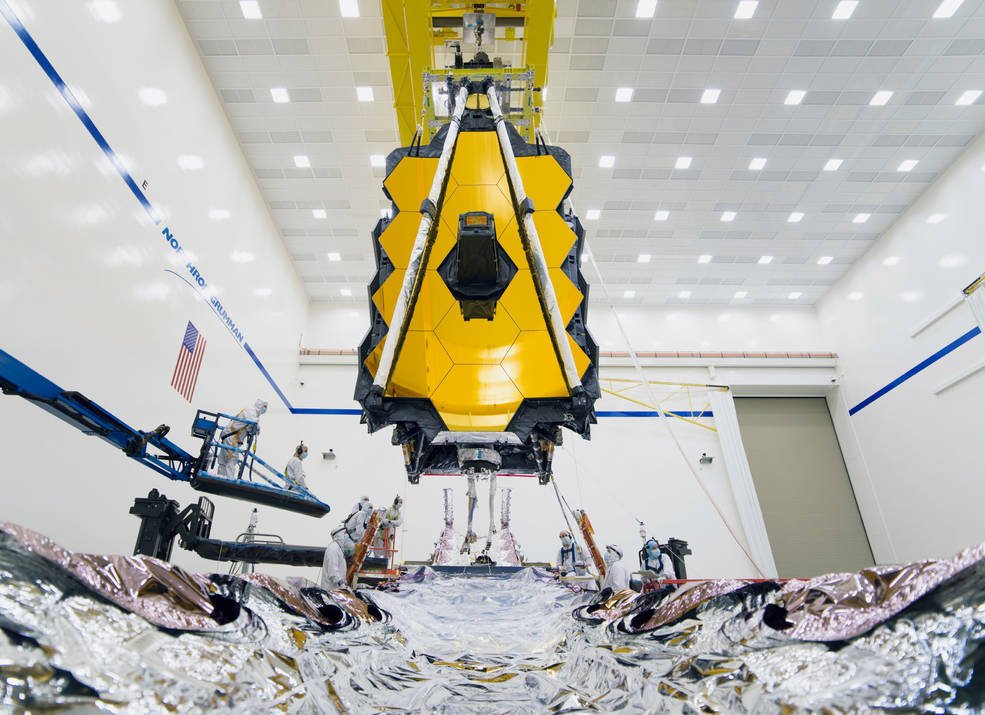
Its most notable feature, a yellow hexagonal mirror system, which measures approximately 6.5 meters in diameter, gives it a wider and deeper view that allows you to observe objects further away compared to other observatories.
The JWST will also be further away; It will orbit from the Earth-Sun L2 Lagrange point at a distance of 1.5 million kilometers (930,000 miles). This makes it impossible to update, as Hubble was, so NASA is doing its best to get it right the first time. ®